
Curiosity Didn't Kill the Cat
Why following a wild curiosity might be the most important thing you do this year.

It was a sunny afternoon on my dear friend Kerrily’s deck in Chicago in 2019 when the question landed between us like an invitation.
Where would you go if you could just go?
I was visiting her family carrying a kind of freedom that many of my friends found quietly enviable, though not for how I’d arrived at it. Divorce sucks. But freedom? Geez, freedom is something else entirely. Kerrily is the kind of friend who delights in your becoming, who lights up at the possibilities your life holds even when you can’t quite see them yourself.
That afternoon, she was living a little vicariously when she pulled up a website. It was called Unsettled and came with the tagline “embrace the unknown”. Catchy. Sticky even.
She had fowarded me an Unsettled email a year before, with a note that read:
“Kathy, you should check out this website for a company called Unsettled. They do these 30-day experiences where you go and work in different countries, different spaces, with a hodgepodge of people. Totally something I would love to do — I can’t for a couple of years until Mads is out of the house, but check it out and keep it in the back of your head...”
I filed it away. Life does that to us sometimes doesn’t it? Just tucks an invitation into a drawer we forget to open, but know somewhere in our bones it’s in there.
But there we were again, a year later, and this time she was reading the descriptions aloud into the sunshine.
Bali. “… local batik painting classes, endless temples, meditation centers…”
Cape Town. “… where two oceans collide, mountains rise…”
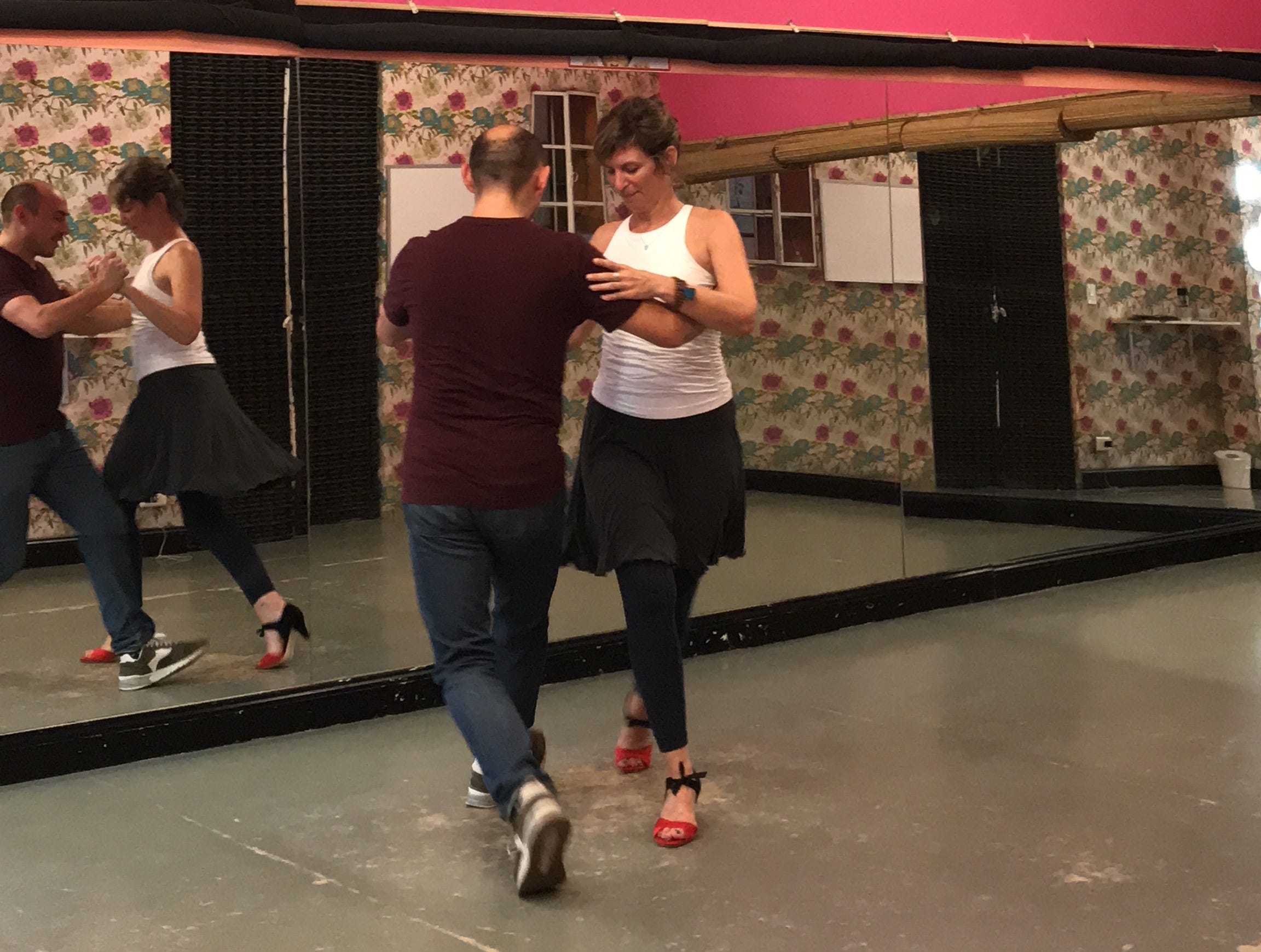
Buenos Aires. “… midnight tango lessons…”
She had me at tango.
I went home and fell into a research rabbit hole that kept me up well past midnight, I couldn’t stop myself. I was entranced. This is what genuine curiosity feels like. Not the quick Google-and-move-on kind. The kind that grabs you by the collar.
Tango, it turns out, is not so much a dance as a feeling that is danced. Its origins are tangled in the margins of Argentina and Uruguay. Performed on the peripheries of cities by those who had been pushed there. The European immigration wave of the 1880s transformed it: smoother in form, but no less sensual, carrying something new— nostalgia. Longing. The ache of people who had crossed an ocean seeking fortune and left everyone they loved behind. Tango songs spoke of unrequited love, loneliness, hardship, unfilled dreams.
I tripped into the research of Argentine political theorist and dance scholar Marta Savigliano, who spent years tracing tango's journey from the margins of Buenos Aires to the cabarets of Paris and beyond. In her landmark work Tango and the Political Economy of Passion, Savigliano argues that tango has always been, at its core, a music of exile — not just the exile of crossing an ocean and leaving your family behind, but what she calls the experience of internal exile: the longing of people who feel like strangers in their own lives. She describes it simply and devastatingly: tango is a sad thought that can be danced. When I read that, I understood why tango had grabbed me so completely from Kerrily's deck in Chicago. I was curious about what it might feel like to stop being a stranger to myself and let out the sadness that felt stuck inside me.
My notes from that deep curiosity dive had random thoughts and quotes scribbled all over pages.
“Tango’s magic lies in its ability to convey emotion in both music and dance.”
“Born from foreigners who could not return to their homeland.”
“A dance led from the heart. Born from the need to make contact with another.”
Somehow these quotes pulled on a string of memory. I wrote in the margin:
I once read that our childhood years are full of suffering from the love we do not receive and our adult years are spent in suffering from the love we do not give.
I know.
I’ll let you read that again.
Our childhood years are full of suffering from the love we do not receive and our adult years are spend in suffering from the love we do not give.
I have no idea where I read that but in the moment, all jacked up on curiosity, it seemed to me that tango was the antidote. A corporeal dialogue, intimate and sensual, that invites you to become the protagonist of an ongoing story. One danced with another through mutual improvisation, an intertwining of spirit and limb. Without saying a word! (Me being honest, this was a dream from the perspective of someone who suppressed her emotions.)
I was gobsmacked. And hungry.
If I could find myself through dance, in a foreign country, with people I had never met, well, that felt wildly safe and exciting to me. I was even more curious, if that was possible.
What I didn’t fully understand at the time was that the research itself, that complete falling in and losing track of hours was allowing curiosity to do exactly what it is designed to do! I wasn’t just learning about tango. I was lighting up the runway for something much bigger.
I booked the trip. (Admittedly, high on the emotion of curiosity.)
Your Brain on Curiosity
Matthias Gruber, a leading researcher at UC Davis, has spent years studying what happens in the brain when curiosity is activated, and the findings are striking.
When we’re curious but haven’t yet found our answer, two regions light up: the midbrain and the nucleus accumbens. These are the same areas activated when we crave something or anticipate a reward. Researchers call this our wanting system. Curiosity makes us lean in. It compels us to seek.
Gruber’s research shows that curiosity also activates the hippocampus which is the region responsible for forming new memories. Which means we don’t just learn the thing we’re curious about more deeply. We retain more of everything around it. Curiosity puts the whole brain into an open, receptive state.
“Our brain just works better on curiosity.” — Matthias Gruber
This is why that midnight research session didn’t feel like studying. It felt electric.
Curiosity Opens More Than Doors
Barbara Fredrickson, whose Broaden-and-Build theory transformed how we understand positive emotions, would tell us that curiosity does something quietly extraordinary beyond the cognitive: it expands us relationally. Positive emotions like curiosity widen the lens through which we see the world, making us more open to other people, more willing to be changed by what we encounter. We don’t just learn more. We become more.
I felt this in Buenos Aires. The dance lessons became something I couldn’t have predicted: a subtle language for parts of myself I hadn’t had words for.
Curiosity as Connection
Brian Grazer, the film producer who spent decades conducting what he called ‘curiosity conversations’ with people from every walk of life, captured something essential:
“We are all trapped in our own way of thinking, trapped in our own way of relating to people. We get so used to seeing the world our way that we come to think that the world is the way we see it.” — Brian Grazer, A Curious Mind
That quote is bothfascinating and dangerous. Think algorithms and how they are really disrupting the flow of us as humans by keeping us in echo chambers.
Curiosity is a positive disruption. It’s what shakes us out of our small, suffocating certainties and makes room for someone else’s experience. The beautiful thing is in doing so, we expand our very own inner world.
When we bring genuine curiosity to another person, something shifts on both sides. The curious person, with their brain primed and open, absorbs not just what is being said but the whole texture of the exchange. The person receiving that curiosity feels heard, and opens rather than closes. It is a rare and beautiful win-win in human connection.
Tango, come to think of it, is just curiosity with more evocative music.
The Opposite of Curiosity
The opposite of curiosity has a name: knowledge conceit.
Really.
It is the belief that you already know everything worth knowing on a subject. It’s dangerous for two reasons. First, it seals you off from having your perspective disrupted by someone else’s truth. Second, from a leadership standpoint, it breeds stagnation. The most effective leaders ask more questions than they give answers. Curiosity keeps the people around you sharp, engaged, willing to think out loud. Not to mention it signals that thinking matters.
Growing Your Curiosity Quotient
So how do we practice this?
Follow the spark. Start by resisting the quick answer. Look it up if you need to, but let it be a springboard, not a landing pad. Let the question breathe before you close it down.
Pause. When someone else’s curiosity triggers a defensive reaction in you, pause before you respond. Get curious about your own reaction first. What’s underneath it? Then turn back toward the other person: I’m curious... Those two words alone can reopen a door that was starting to close.
Dig deeper. If something genuinely fascinates you, follow it. Past midnight if you have to. TED Talks, Coursera, edX. Honestly, the rabbit holes are endless and almost always worth it. Don’t just skim the surface. Swim in it. Let the current take you somewhere unexpected.
Flip. Notice what makes you angry. Anger, I’ve found, is often just unexplored curiosity in disguise. Dig into it. That excavation is sometimes where a passion and maybe even a purpose quietly lives.
I went to Buenos Aires. I took tango lessons at midnight. I danced with strangers and found something in myself I had set down somewhere along the way. It was proof to myself and perhaps now to you that…
Curiosity didn’t kill the cat.
It can, however, bring that beautiful feline back to life.
Maybe that’s why cats have nine lives. 🤔
Kathy - I don’t know how this ‘tango’ trip has not come up in any of our conversations…you’re full of surprises, my friend! This gives me a “Eat - Pray - Love” 😍