
Finding Peace Within: When the Center Must Hold
What a giant peace sign taught me about surviving life's unraveling.

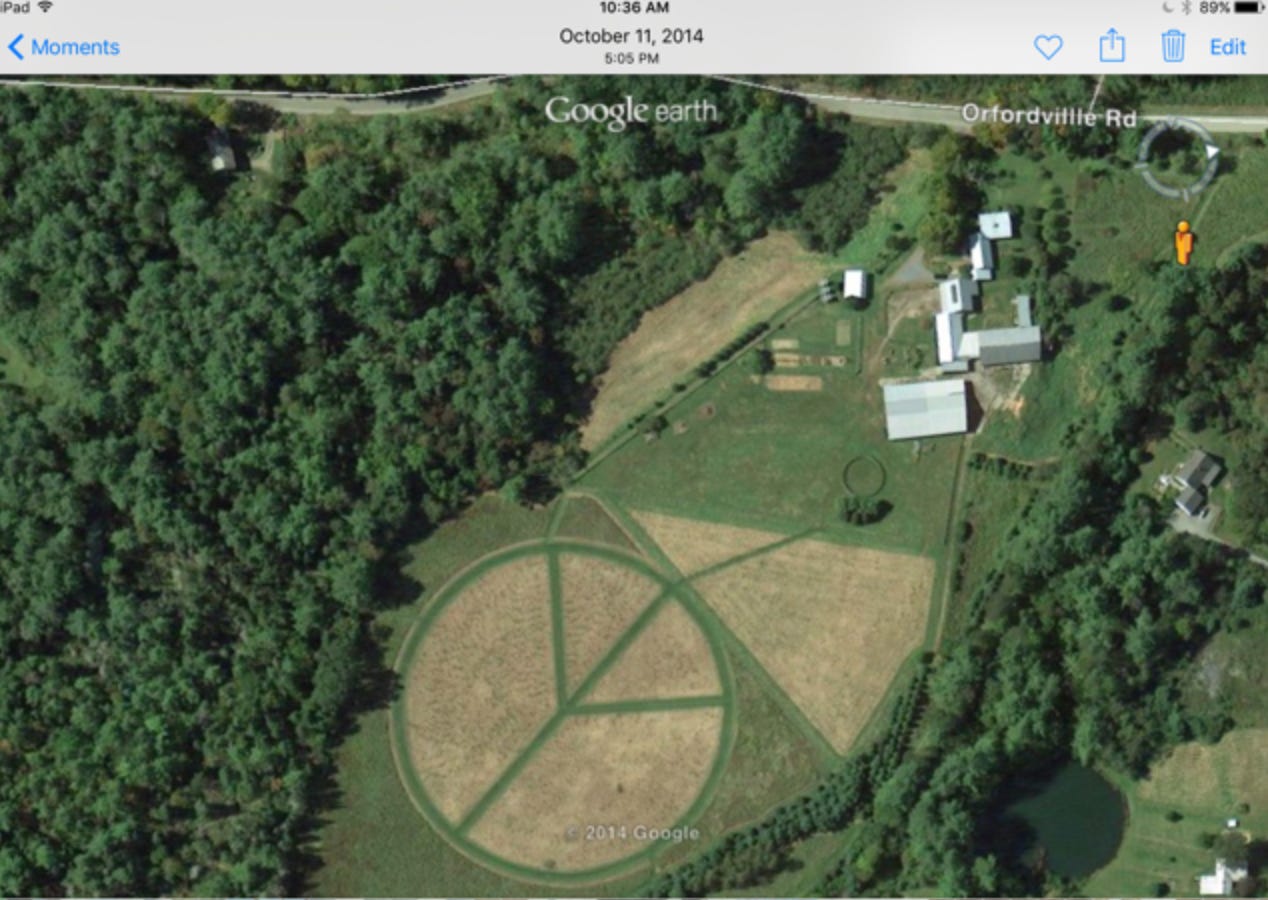
When I first purchased my house, a Google Earth search revealed something extraordinary: a massive peace sign etched into the earth nearby. I took it as a sign—I take everything as a sign—and this one validated a big step into what felt like an edgy, exciting, and perilous (in a good way) kind of love. We'd only been dating a short time when a job change sped up our future, and I jumped. I consider this kind of recklessness a long-term side effect of being a cancer survivor. We don't look at time the way others do, having had the gift of getting up close with our mortality. It was a special collision, he understood that close up to mortality kind of thing.
Just weeks after we moved in, a kind man walking his dog welcomed us to the neighborhood. David, clearly a steward of the earth, invited us to use the many trails on his property—the very property that contained that large peace sign I'd seen from above! What are the odds?
Walking the Peace Sign
For almost a year, I walked David's trails through the seasons without seeing him. Then one day, he met me on the path, sharing that it was nice to see someone walking the peace sign. I had been walking it almost daily since the end of my relationship—it turns out we humans sometimes want different things, and that is both okay and painful at the same time. I can’t help but think of the lyrics "Love is only equal to the pain" from the song Let Somebody Go duet magic between Coldplay and Selena Gomez.
David asked if my partner rode a mountain bike because he'd seen tracks. I began to cry.
He was so gracious. Just held space with me, a total stranger. That is kind of ethos here in the place I have landed. Humanity meeting humanity on the path of life.
After our connection, I sent him an email asking about the peace sign's creation. His response revealed that he and his late wife Helene had laid it out in spring 2003 as the country went to war "for all the wrong reasons." Helene was the real inspiration. He has continued mowing the path to peace ever since. What struck me most was his honesty about the contradictions—feeling guilt for burning fossil fuels while mowing, yet finding that coyotes came to feast during his work, and that he almost never begrudged the labor.
The Choice Point
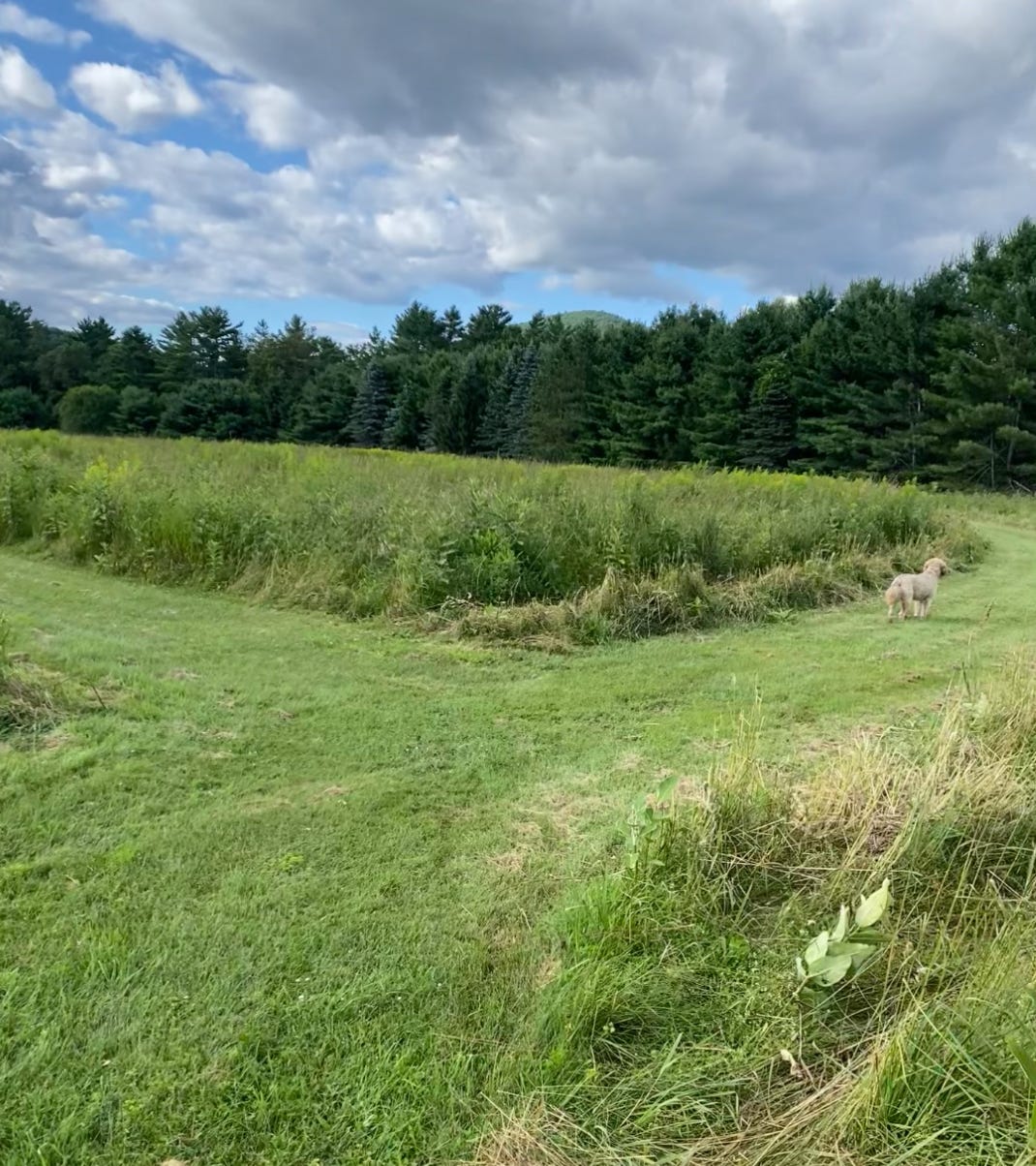
My favorite part of the peace sign is where all the pieces meet—the choice point where I must decide which way to go. My dog, Bodhi, runs up and back while I ponder, just standing there for a hot second. I've tried every path to ensure I cover the entire thing, but more importantly, it's about choosing from my own center.
One of my clients recently shared with me the phrase"The center will hold." When I asked her to explain, she shared that all will be okay — there was a whole bunch of tumult going on in her life but the center of her would still be there. I dove into literature and found the phrase draws its power from William Butler Yeats' poem "The Second Coming," where he wrote, "Things fall apart; the centre cannot hold"—an expression of despair after World War I. The modern reversal, "the center will hold," becomes an affirmation of resilience in the face of disorder.
As author Richelle Mead wrote: "The center will hold. How do you know? Because we are the center."
Peace and Conflict: Two Sides of the Same Coin
I believe conflict is the other side of the same coin as peace. Peace cannot happen without conflict, and conflict cannot happen without peace. It's like positive and negative emotions—we wouldn't know joy without sadness. The cracks are what let the light in. (Thank you Leonard Cohen.)
The modern peace sign, designed by Gerald Holtom in 1958 for nuclear disarmament, carries this duality in its very design. The letters "N" and "D" in semaphore, enclosed in a circle, but Holtom also described it as representing despair—a human with hands outstretched in questioning against the backdrop of Earth.
Finding Your Center
Finding your center is a bit like dating yourself. First, you discover your strengths and understand your saboteurs—those things that hold you back. Then you define your personal values, those things you'd die on a sword for that help define what you stand for. You no longer fall for what others want and value; instead, you support them in their efforts because it's not tied to your center.
For me, the conflict I've always carried was people-pleasing and emotional suppression, scattering my attention instead of fully attending to myself or others. Finding symmetry in this "smoosh" means realizing that when I step away from that habitual pattern and find peace by attending to myself, I can better attend to those outside of me—without being responsible for their response.
This is something I've done my entire life, so I have yet to be skillful at it. But I'm learning that releasing this pattern is what freedom feels like. When people take responsibility, it gives them ability. (Respond-ability :) There's no need to throw arrows of blame. It is not a zero sum game, no one has to lose. In fact we all win when we come from that center of peace.
The Practice of Peace
Alexandra Roxo author of Dare to Feel asks us "Is it sitting against a tree and breathing even when you feel despair? Is it poetry? What is it that can give you a little bit of connection to yourself and a little bit of courage to stay with it and stay curious?"
Sometimes it's enough self-awareness to say, "Wow, I'm really in it." That's witnessing yourself. You might go straight back to that voice of "woe is me," but now you know that's not actually your voice—that's something inside longing to be healed.
Writing becomes a gateway to this awareness. Journaling is where we begin to learn to "listen" to our minds, hearts, and souls, creating attunement with our own authenticity. The words journal and journey both can take you down a path of awakening. (The genius of Lisa Weinert can also take you there.)

Walking Your Own Peace Sign
David's peace sign continues to be mowed each year—a physical labyrinth that honors both the hope for peace and the acceptance of ongoing effort required to maintain it. Like that sacred choice point where all paths meet, each day offers us countless opportunities to choose differently.
The peace sign taught me that conflict and peace aren't opposites—they're partners in the dance of authentic living. Every time we honor our truth instead of managing others' comfort, every time we admit what we desire, every time we choose vulnerability over perfection, every time we stay present with difficult emotions instead of escaping into distraction, we're carving our own peace sign into the landscape of our lives.
This isn't about becoming conflict-free—that's neither possible nor desirable. It's about becoming conflict-capable: able to navigate disagreement, disappointment, and difficult emotions while staying anchored in your essential self.
As Cheryl Richardson reminds us: "If you avoid conflict to keep the peace, you start a war inside yourself."
The real work isn't avoiding the storms—it's learning to be the calm within them.
Your center will hold because you are the center. And from that place of groundedness, you can walk your own peace sign, one conscious choice at a time, carrying your hard-won wisdom into a world that desperately needs more people willing to do their inner work.
What would change in your life if you truly believed your center could hold? I'd love to hear your thoughts—this journey toward authentic peace is too important to walk alone.